Working Show-Side - Lessons From "Being In The Room"

This post is a little less technical than what I've been writing mostly. It's about my time working show-side in VFX and the lessons I learned.
Background
In 2026, I spent 6 months working on a large scale film production involving the biggest vendors in the industry. I learned a huge amount and I'm excited to share what I can. It was challenging at first to switch gears from my previous, more technical role. Honestly, I only really got good at this job about 5 months and 29 days in, but this experience gave me a valuable perspective that I'm hoping to share here.
Know What You Know
If you're coming over from working at a vendor, it's possible to feel a little intimidated by the idea of switching things up and taking on the other side of the client-vendor relationship. I definitely found it jarring. Knowing companies like ILM, Framestore, and Wētā in the VFX landscape to be these big behemoths, it was surreal to be in a role working with all of them at the same time. This came with a huge amount of imposter syndrome.
The truth is, coming over from a vendor, working client-side as a coordinator is largely an extension of the processes you're already familiar with, especially in the coordinator role. Some of your core duties are just flipped (dispatching materials and references rather than receiving them), and your place in the review process extended. One example of this symmetry is the way the work itself is viewed and reviewed.
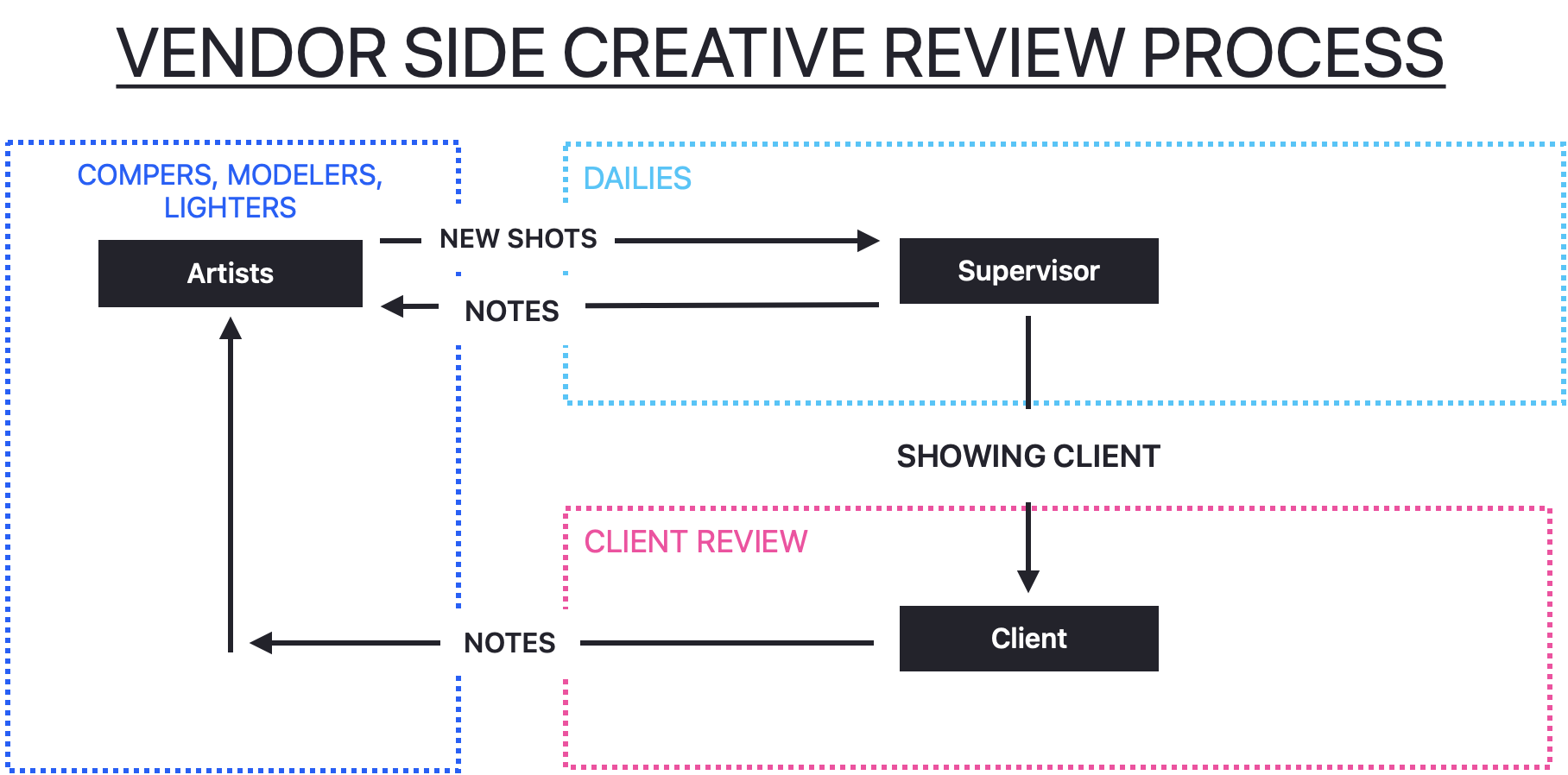
This is the review workflow at a vendor:
...and this is the review workflow on the client side:
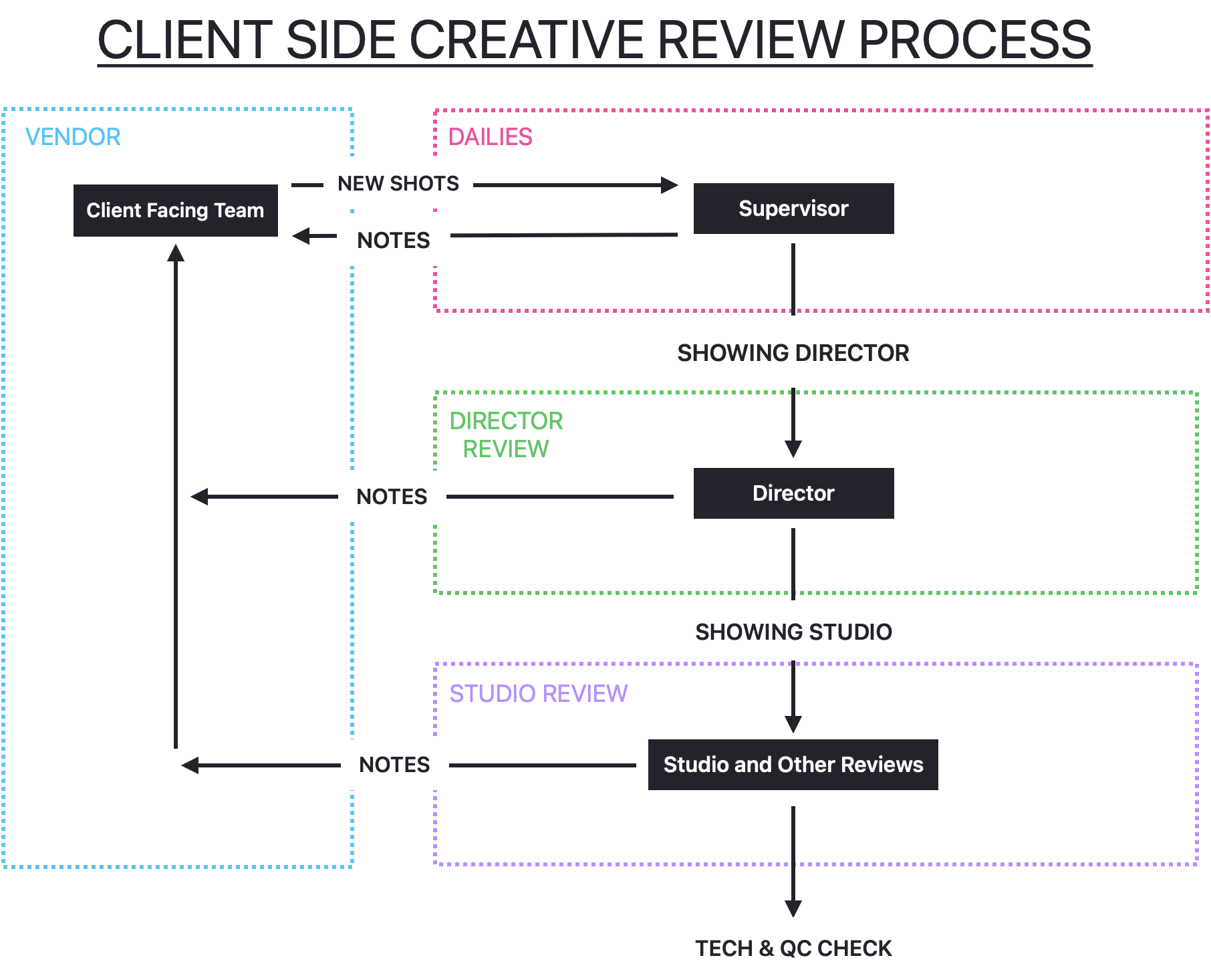
You'll notice that the cycle of figuring out what to show the next group of people downstream and providing notes to the people upstream is consistent across both workflows.
Another important symmetry is the relevance of production tracking tools. You'll largely live in a database as a coordinator client-side just as much as you would vendor-side. Where vendor-side, a series of shots might be assigned to a group of artists, on client-side, they're assigned to whole vendors, but as I've written before, there's a lot of overlap.
It's important to recognize you're still making visual effects here: being used to driving a project forward, following up with people, being assertive when important questions need to be asked, knowing who needs what and why are all essential transferable skills. The takeaway is that it's helpful to do an assessment of what you already know, just as you should assess what you don't. Which leads me to my next lesson.
Find Out What You Don't Know
Context on shows like this is very important. Knowing the history of shots is so much of what you're hired for. What happened two versions ago? Why is this new one missing the thing we talked about last week? Why are there 20 notes about this one hair matte? Being able to answer these sorts of questions on the fly is the job in a nutshell. The database you maintain as a coordinator supports this, but it's very much the case that you, the human, are being asked to know and communicate the work done and left to be done on a show. You're at your most useful on a team like this when you can actually answer questions quickly from memory, rather than more robotically looking things up. Databases help you answer questions, but your brain helps you ask the right ones, and that's where taking a beat to recognize where you may need more context can take you far. I learned early on that leaning on my teammates for certain details while I filled in the gaps was not only good for my knowledge of the show, but necessary to moving the project forward.
Talking databases specifically for a moment, coming onto a new show or a new side of the industry, you can be presented with a whole new way of managing information. My team used FileMaker instead of ShotGrid, and that added a learning curve. My pipeline brain was hard to switch off and I found a lot of choices puzzling. As time went on, I learned a lot about why things were the way they were. I've heard advice given to junior pipeline TDs that they ought not jump in thinking they have the one and only solution to everything and anything at the start, which is a tempting way to think. Instead, it's good advice to take a sec (or a few months) to survey the work being done to try to understand and learn about existing plans and methods to see why they are set up that way.
Relationships And Trust Are Huge
On the topic of relationships, people in this industry often discuss them in terms of knowing someone who knows someone, or maintaining a relationship where one person views another as reliable, or honest, or capable. One of the bigger differences I noticed working client side was that the interpersonal aspects were a lot more intense. Specifically, your relationships with your colleagues as a team. For example, a good joke could land you in someone's favor just as much as a quick solution to a pressing problem (extra points for doing both). This isn't to say that client side felt strictly like a popularity contest, but rather that in such a creative environment, being able to manage and contribute to the overall workplace milieu is huge.
Plenty of people prefer to avoid the more interpersonal dynamics at play in an office that might distract from their immediate work-related output, and I do see where they are coming from. However, in the specific arena of client-side VFX filmmaking, these dynamics matter, and relationships count because trust counts. What I mean by that is it inherently needs to be a risk-friendly environment. Creatives and those around them need to live in a safe space to do what they do. 100 million dollars may be on the line, but if the vibes at the office are positive, collaborative, and open, a lot of that pressure can become background noise. Client side is a space where you are there to serve the primary creatives involved in a project, so bringing your whole self to work in a way that helps rather than hinders creativity is core.
Ambient Learning
Many vendors have opted, since the pandemic, for hybrid or remote work setups. It's very much the case that most client-side work is still done in-person. The biggest lesson I'll share from my experience working on this project was the lasting impression in-person work left with me. Working with a team 5-6 days a week, for 12 hours a day was absolutely grueling at times, but I ended up learning so much from my colleagues each day. Sitting next to the VFX Supervisor during dailies, watching how he holds himself, how he conducts sessions, seeing things the way he sees them in a shot. This is often referred to as institutional absorption, ambient learning, or acculturation (a literal anthropological term). The things you can absorb just by being around people doing the thing you want to do are plenty. It's this last lesson that is going to have me looking for in-person work next, or at the very least hybrid. I know the discussion has been controversial in some spaces, so take that as you will.